Boiler Repair and Maintenance Guide for Toms River and Ocean County Homeowners
October 6, 2026
Seasonal HVAC Maintenance Contracts: What Toms River Homeowners Should Know
October 20, 2026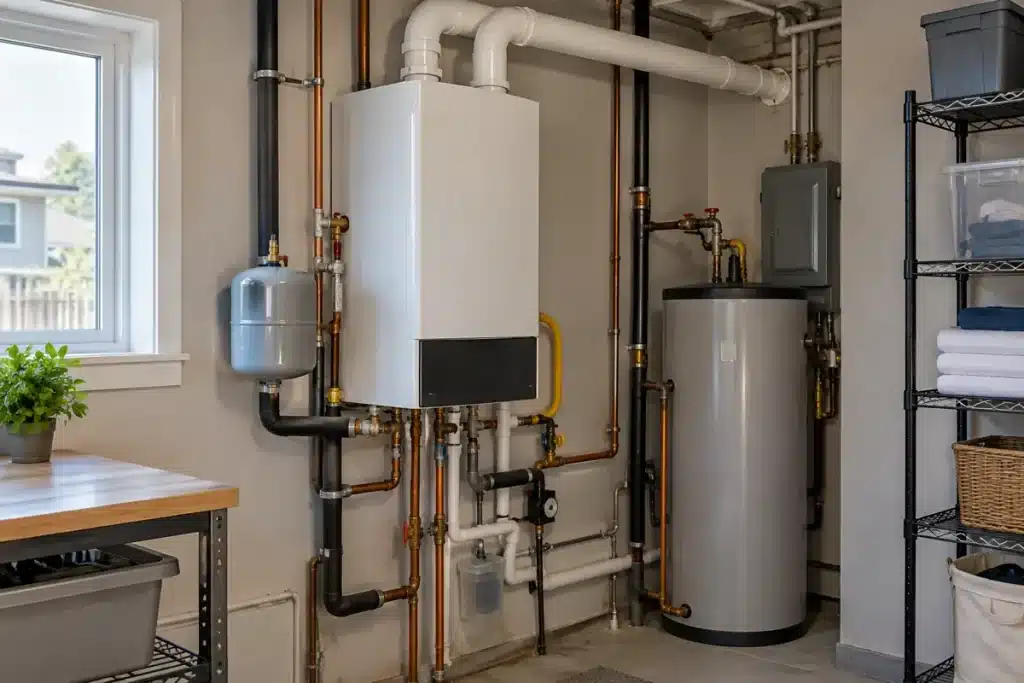
Quick answer: A Navien combi boiler is a single wall-hung unit that heats your home and provides continuous domestic hot water without a storage tank, as long as demand stays within the unit’s rated capacity; it can save space and may improve efficiency over some separate boiler and water heater setups. It suits Ocean County homes with hot water boilers, limited mechanical space, and moderate hot water demand, but proper sizing, venting, and gas line work are essential.
Key takeaways
- A Navien combi boiler combines space heating and tankless hot water into one wall-hung appliance, freeing up floor space that a separate tank water heater would otherwise use.
- According to Navien, installing a combi boiler does not require special procedures beyond a standard condensing boiler and tankless water heater install, and can reduce venting penetrations and gas piping compared to two separate appliances.
- Venting placement is governed by the adopted code, local requirements, and Navien’s installation manual; required clearances depend on the appliance and the type and location of nearby openings.
- In New Jersey, state boiler inspection rules generally apply only when specified capacity and occupancy thresholds are met; typical one- and two-family residential boilers generally do not fall under that state inspection program.
- Combi boilers work best for homes with moderate, staggered hot water demand; large households running multiple showers at once may want a dedicated tank or larger-capacity unit instead.
What Is a Navien Combi Boiler and How Does It Work?
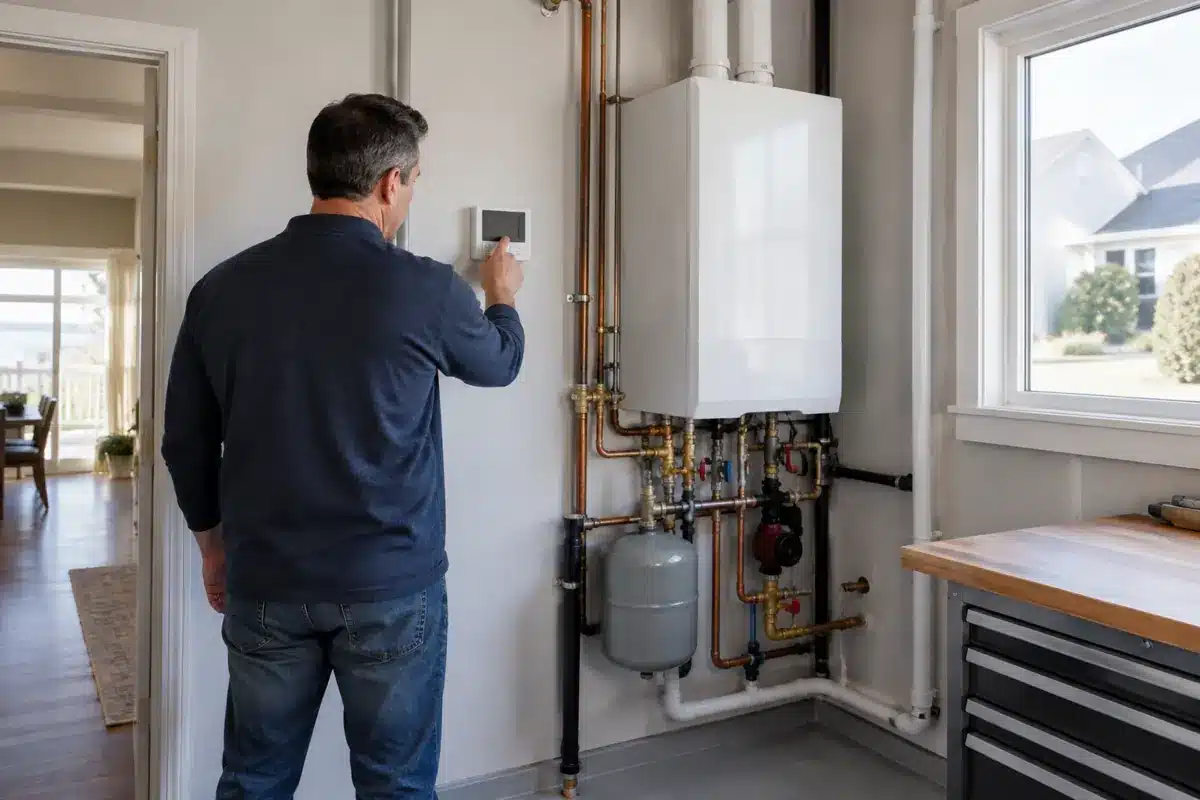
A combi boiler, short for combination boiler, is a single appliance that heats your home and supplies hot water on demand, replacing a separate boiler and a storage-tank water heater. Navien’s NCB-H series is a wall-hung, condensing combi boiler that pulls double duty: when you turn on a faucet, it instantly fires up to heat water as it flows through, and it also circulates hot water through baseboards, radiators, or radiant floor loops to heat your living space.
Because there is no storage tank, you are not paying to keep 40 or 50 gallons of water hot around the clock. The unit heats domestic water on demand, while its condensing design can recover additional heat from exhaust gases when operating conditions allow. For help with terms such as condensing and BTU, visit our common HVAC terms page.
Who Is a Good Fit for a Combi Boiler in Ocean County?
Combi boilers tend to make the most sense for homes that already use a hot water (hydronic) heating system, since the combi unit simply replaces the old boiler and tank water heater with one appliance. That describes a large share of older homes across Toms River, Brick, and Lakewood, many of which still run on boilers installed decades ago.
They also suit homes where mechanical room space is tight, which is common in shore and vacation properties around Point Pleasant, Lacey, and Beachwood where utility closets were never designed with a full-size tank in mind. A combi unit mounted on the wall frees up floor space for storage or laundry equipment.
Combi boilers are a weaker fit for larger households that regularly run two or more showers plus a dishwasher and washing machine at the same time, since a single combi unit has a flow-rate ceiling. In those cases, a properly sized higher-capacity combi model, a separate domestic hot-water storage solution, or separate heating and water-heating appliances may serve the household better. A licensed technician should run the numbers on your actual fixture count and peak demand before recommending a specific model.
Efficiency Benefits: Why Homeowners Consider Switching
The main draw of a condensing combi boiler is that it extracts extra heat from exhaust gases that a standard boiler simply vents outside, which is why these units often reach higher efficiency ratings than older, non-condensing equipment. Replacing an aging oil or standard gas boiler with a modern condensing combi can lower fuel use, though actual savings depend on your current equipment’s age, your home’s insulation, and how the system is sized and installed.
Space heating and hot water from one appliance also means one set of venting, one gas connection point, and in many cases fewer wall or roof penetrations than installing two separate systems, according to Navien. That can simplify both the installation and future maintenance visits.
Homeowners converting from oil or propane to natural gas sometimes pair that switch with a combi boiler upgrade. D.K. Sledzik Heating & Air Conditioning has converted thousands of homes from oil, electric, and propane to gas as a recommended contractor of New Jersey Natural Gas, and a combi boiler is one of the equipment options available during that kind of conversion.
Installation Requirements: Venting, Gas Lines, and Water Quality
A combi boiler installation is not a simple swap-and-go project, even though Navien notes it can be comparable in scope to installing a standard condensing boiler and tankless water heater together. A few technical requirements matter most:
Venting
Navien combi boilers use direct venting with materials and terminal arrangements approved in the model’s installation manual. The vent system must comply with that manual, New Jersey’s adopted code, and local requirements, including applicable clearances from grade, snow accumulation, doors, windows, air intakes, and other openings; terminal screens should be used only when approved for the specific system.
Gas Line Sizing
A combi boiler may have a higher maximum gas input than the tank water heater it replaces, so the installer must verify gas-pipe capacity and available pressure for the full connected load. Existing gas lines sized for older, lower-output equipment may need to be upsized to deliver enough gas volume at the pressure the new unit requires.
Water Quality and Flushing
Hard water and mineral buildup can affect the heat exchanger in any tankless or combi system over time. A water quality check, and sometimes a scale-reducing filter, is worth discussing with your installer, particularly in areas with harder well or municipal water.
Permits and Inspections
New Jersey’s Uniform Construction Code requires the appropriate municipal permits for a new boiler installation. Recurring inspections by the state’s Boiler and Pressure Vessel Compliance program apply only when the boiler and building meet specified capacity and occupancy thresholds. Your contractor should pull the required permits and schedule inspections as part of the installation.
| Installation Factor | Why It Matters |
|---|---|
| Venting path and clearances | Must meet code distances from windows, snow line, and between intake/exhaust to avoid exhaust recirculation |
| Gas line diameter | Combi units can require higher gas flow than the tank water heater they replace |
| Water hardness | Scale buildup can reduce heat exchanger performance over time without treatment |
| Mounting location | Wall-hung design needs structural support and clearance for service access |
| Local permits | NJ Uniform Construction Code requires permits; some boilers require ongoing state inspection |
Combi Boiler Pros and Cons
Combi boilers solve real space and efficiency problems, but they are not the right answer for every home. A balanced look helps set expectations before you commit.
- Pro: One appliance replaces two, freeing mechanical room floor space.
- Pro: No standby tank losses, since the unit only heats water on demand.
- Pro: Condensing technology typically improves efficiency over older, non-condensing boilers.
- Pro: Often fewer venting penetrations than installing a separate boiler and tankless water heater.
- Con: Flow rate is limited, so very high simultaneous hot water demand can outpace a single unit.
- Con: Installation can become more involved when gas, venting, electrical, condensate, or system-piping upgrades are needed.
- Con: Requires a qualified technician for programming, gas pressure setup, and ongoing service, since the unit touches gas, electrical, and plumbing systems at once.
Warranty and Maintenance Expectations
Warranty terms vary by manufacturer and model, so homeowners should review the specific documentation for the unit being installed. D.K. Sledzik provides a 10-year manufacturer warranty and a 5-year labor warranty with new furnace and air conditioning replacements; ask what manufacturer and labor coverage would apply to the specific combi boiler installation.
Routine maintenance is important because a combi boiler provides both space heating and domestic hot water. An annual check of the heat exchanger, venting, water quality, and gas combustion settings helps the unit run safely and efficiently for years. If you already have an older boiler and are weighing repair versus replacement, our Residential Boiler Repair and Care page covers common warning signs, and our HVAC maintenance frequency guide explains how often different equipment types need a tune-up.
Financing and Rebates for Combi Boiler Installation
High-efficiency combi boilers can qualify for New Jersey Clean Energy Program rebates and NJNG SAVEGREEN on-bill repayment financing, though program terms and amounts change and should be confirmed directly at NJCleanEnergy.com or savegreenproject.com before you budget for a project. D.K. Sledzik can walk homeowners through current rebate and financing options as part of a consultation, and the Upgrade and Save page outlines the general programs available.
D.K. Sledzik also offers free estimates and financing upon request for qualifying homeowners, which can make a combi boiler upgrade easier to plan around a household budget. You can read customer feedback on our customer testimonials page, or browse the full range of equipment brands we install, including Navien, Burnham, and Weil-McLain.
How to Decide if a Navien Combi Boiler Is Right for Your Home
- Confirm your current heating system type. Combi boilers are a natural replacement for existing hot water (hydronic) boilers; forced-air furnace homes need a different conversation.
- Count your peak hot water fixtures. Add up how many showers, dishwashers, and washing machines might run at the same time during a typical morning.
- Inspect your mechanical room. Note the distance to exterior walls for venting and the proximity to existing gas and water lines.
- Ask about gas line capacity. A technician can measure your existing line and tell you whether it needs upsizing.
- Request a written consultation. A licensed HVAC contractor should size the unit to your home and fixture count, not just swap in a same-size replacement.
- Review warranty and rebate paperwork together, since financing terms and manufacturer warranties both affect the total cost of ownership.
If you are still deciding between a combi boiler and separate heating and hot water equipment, our team can walk through the tradeoffs during a home visit. You can review our full heating and air conditioning services or check our HVAC FAQ for more background before you call.
Frequently Asked Questions
How long does it take to install a Navien combi boiler?
According to Navien, replacing an existing combi boiler with the same fuel source and connections can often be completed in a few hours. A first-time installation, fuel conversion, or job requiring new gas or venting work can take longer; the installer should estimate the schedule after evaluating the home’s layout and project scope.
Can a combi boiler replace an oil boiler and tank water heater at the same time?
Yes, and this is a common project. D.K. Sledzik has converted thousands of Ocean County homes from oil, electric, and propane to natural gas, and a combi boiler is one option during that type of conversion, since it combines the new heating source and hot water supply into a single appliance.
Will a combi boiler run out of hot water with multiple showers running?
It can, since combi units have a maximum flow rate rather than a storage tank to draw from. If your household regularly runs two or more showers plus appliances at once, a larger-capacity combi model or a separate tankless water heater and boiler setup may be a better match.
Do combi boilers work with radiant floor heating?
Yes, Navien’s NCB-H series is designed to work with baseboard, radiator, and radiant floor distribution systems, often through a manifold kit for multi-zone setups. The right configuration depends on your existing piping layout, which a technician should evaluate during a site visit.
Does a combi boiler need an expansion tank?
Expansion-tank provisions vary by model, and the required capacity depends on the heating system’s total water volume and operating conditions. The installer should follow Navien’s manual and verify whether any built-in capacity is sufficient or an external expansion tank is required.
Is a permit required to install a combi boiler in New Jersey?
Yes, New Jersey’s Uniform Construction Code requires a permit for new boiler installations, and some hot water boilers fall under ongoing state inspection requirements. A licensed contractor should handle permitting and scheduling of any required inspections as part of the installation.
Sources
- Condensing Tankless Combi-Boilers | Navien
- Combi-Boiler Installation | Navien
- How to Install a Combination Boiler Water Heater – This Old House
- Public Safety and Occupational Safety and Health | Mechanical Inspection Bureau of Boiler and Pressure Vessel Compliance
Talk to a Local HVAC Team You Can Reach
D.K. Sledzik Heating & Air Conditioning, Inc. has served Toms River and Ocean County homeowners since 1974, with service within 24 hours, 7 days a week, including holidays, at 732-349-0389. Schedule service online or contact us with a question about your system.
Written by the team at D.K. Sledzik Heating & Air Conditioning, Inc., a family-owned HVAC contractor in Toms River, NJ since 1974. NJ Master HVACR License #19hc00168400 · NJ Home Improvement Contractor #13VH01401100.