Smart Thermostat Installation in Toms River: What Homeowners Should Know
October 27, 2026
24/7 Emergency HVAC Response in Ocean County, NJ
November 10, 2026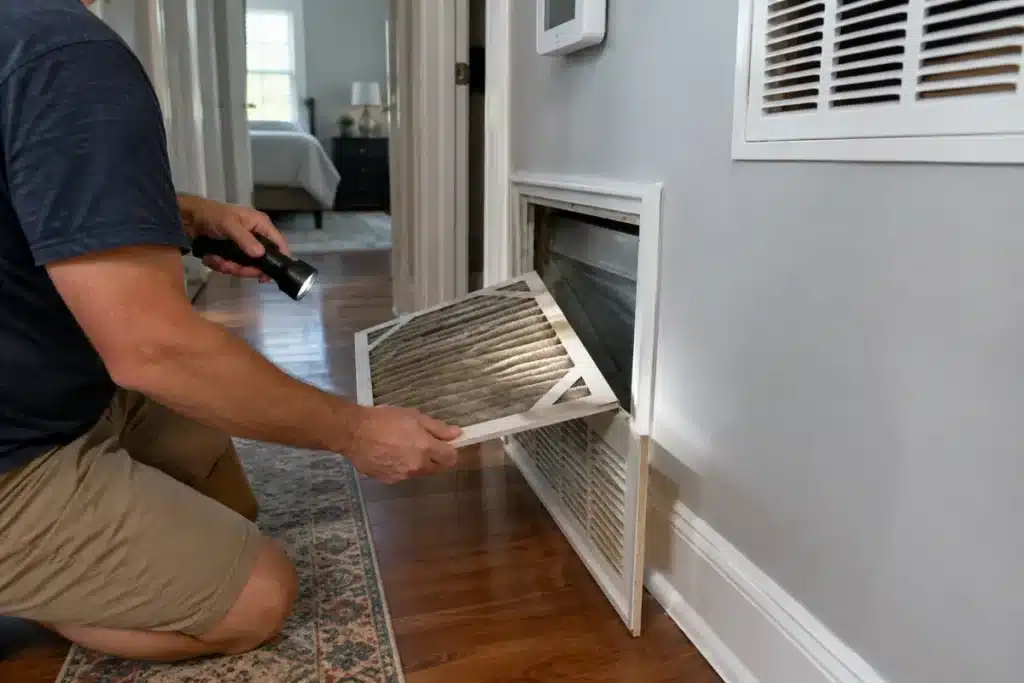
Quick answer: Safe DIY HVAC maintenance includes checking air filters monthly and replacing them when dirty or as the equipment manufacturer directs, clearing the condensate line, keeping 2 feet of clearance around the outdoor unit, vacuuming vents, and checking thermostat batteries where applicable and testing carbon monoxide alarms according to the alarm manufacturer’s instructions. Leave refrigerant, electrical, and gas burner work to a licensed HVACR contractor for safety and code compliance.
Key takeaways
- Check your furnace or AC filter monthly and replace it when dirty or as the equipment and filter manufacturers direct; homes with pets or renovation dust may need more frequent changes
- Keeping the area around the outdoor unit clear and checking an accessible condensate drain are useful DIY tasks
- A clogged condensate drain can cause indoor water leaks; inspect accessible drain components and follow the equipment manufacturer’s cleaning instructions
- Never remove panels to touch refrigerant lines, electrical components, or a gas burner assembly yourself; that work requires a licensed HVACR technician
- Test smoke and carbon monoxide alarms as their manufacturers direct, replace batteries when required, and replace each alarm by its labeled end-of-life date
Which HVAC Tasks Are Actually Safe for Homeowners to Do?
Most homeowners can handle a handful of simple, low-risk tasks that keep an HVAC system running cleanly between professional visits. These include changing filters, clearing debris from the outdoor unit, flushing the condensate line, vacuuming vents and registers, and swapping thermostat and carbon monoxide detector batteries.
None of these tasks require opening an electrical panel, handling refrigerant, or touching a gas burner. They’re the kind of maintenance that ENERGY STAR lists under its own “actions to do yourself” category, separate from the work a contractor should handle during a seasonal check-up.
We serve homes across Toms River, Brick, Lakewood, Jackson, Manchester, Berkeley, Beachwood, Lacey, Whiting, and Point Pleasant, and salt exposure, humidity, and storm debris can be hard on outdoor equipment near the Jersey Shore. A little regular homeowner upkeep goes a long way toward protecting the investment you’ve made in your system.
How Often Should You Clean or Replace Your AC and Furnace Filters?
A dirty filter can reduce airflow, increase energy use, and contribute to equipment wear, according to ENERGY STAR. A clogged filter forces your blower motor to work harder, and in cooling mode it can cause the evaporator coil to freeze, which leads to water leaking from vents.
Step-by-step filter check
- Turn off the system at the thermostat before opening the filter compartment.
- Locate the filter, usually in the return air grille, a slot near the air handler, or inside the furnace cabinet.
- Slide it out and inspect it for visible dirt or loading. Replace it when dirty or when the filter or equipment manufacturer recommends.
- Check the airflow direction arrow printed on the frame and install the new filter facing the same way.
- Write the installation date on the frame with a marker so you know when to check again.
ENERGY STAR recommends inspecting the filter monthly and replacing it when it looks dirty, or at least as often as the equipment manufacturer directs. Monthly inspection is a practical habit for any home, with more frequent replacement when the filter becomes visibly dirty. Homes with pets, recent renovation dust, or allergy concerns should check even more frequently.
How Do You Inspect a Heat Pump or Outdoor Condenser Yourself?
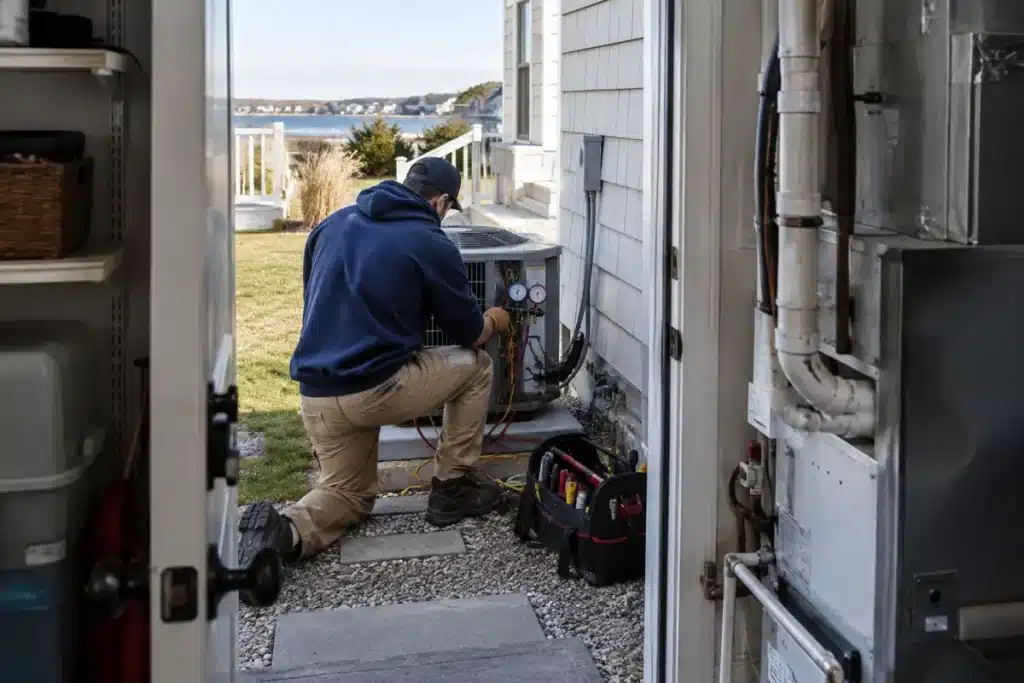
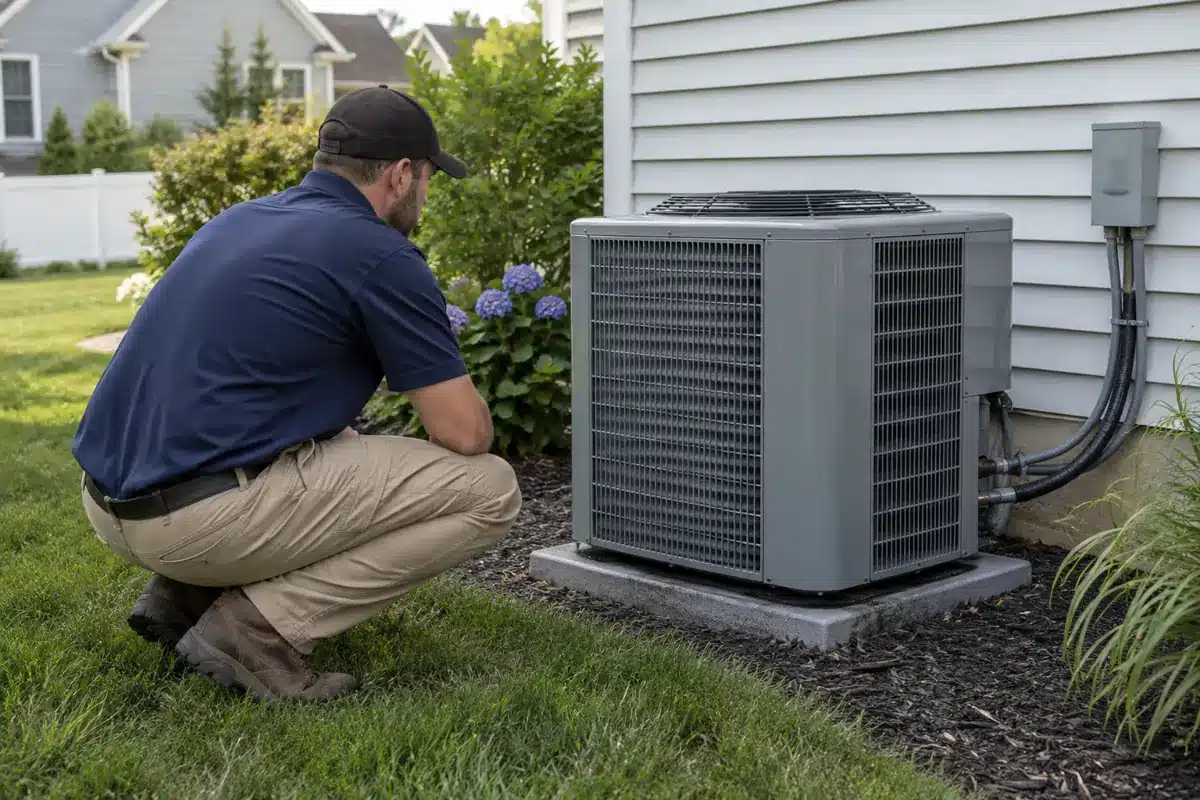
You don’t need tools or technical training to do a basic visual inspection of your outdoor unit. The goal is airflow: a heat pump or AC condenser needs open space around it to pull in and release air efficiently.
- Clear a 2-foot radius around the unit, removing leaves, mulch, mower clippings, and overgrown shrubs.
- Check for debris on the coil fins and gently rinse them with a garden hose on a low setting, never a pressure washer, which can bend the thin aluminum fins.
- Look at the base pad to confirm the unit is still level; shifting ground near the shore and freeze-thaw cycles can tilt a pad over time.
- Listen for unusual noise such as rattling, grinding, or a hum that wasn’t there before.
- Check after storms. Our FAQ notes that windblown debris can damage an outdoor unit, so check for debris after significant wind events.
If you notice bent fins, standing water that won’t drain, ice buildup on the lines, or a burning smell, stop and call a professional rather than troubleshooting further.
How Do You Flush a Condensate Line Safely?
Your air conditioner removes humidity from the air as it cools, and that water has to go somewhere. A PVC condensate line carries it outside or to a floor drain, and algae or sludge buildup inside that line can cause drainage backups, indoor water leaks, and musty odors.
Simple condensate line flush
- Locate the PVC pipe near your indoor air handler or furnace, usually with a T-shaped access fitting with a cap.
- Turn off the system.
- Check the equipment manual before opening or adding anything to the drain. If the manufacturer provides a homeowner cleaning procedure, follow its specified cleaner, amount, and schedule.
If water is already pooling under the indoor unit, backing up into a pan, or you see signs of a clog that won’t clear, that’s a sign of a bigger blockage or a failed condensate pump, and it’s time to call a pro rather than keep flushing.
What Other Simple Maintenance Should Homeowners Do Year-Round?
Beyond filters and the outdoor unit, a few more habits protect comfort and safety without any special skills.
| Task | How Often | Why It Matters |
|---|---|---|
| Vacuum supply and return grilles | As needed | Removing surface dust keeps grilles clean and unobstructed |
| Check thermostat batteries and test CO alarms | As each manufacturer directs | Working CO alarms are essential in homes with fuel-burning equipment |
| Compare the thermostat reading with room conditions | Each season | An inaccurate reading can affect comfort and system runtime |
| Keep return air paths unblocked by furniture | Ongoing | Blocked returns strain the blower and reduce system efficiency |
| Note any unusual sounds, smells, or short-cycling | Ongoing | Early signs often prevent an expensive breakdown |
For summer, set the thermostat as high as is comfortably practical and use an appropriate setback when the home is unoccupied; the best settings depend on the household, system, and humidity conditions. If you want more control over these settings without manually adjusting them, our smart thermostat installation and optimization service can automate it.
What Tools Do You Need for Basic HVAC Maintenance?
You don’t need a full toolbox for the tasks above. A basic kit covers nearly everything a homeowner should attempt:
- Replacement filters sized to your system (check the frame for dimensions)
- A soft-bristle brush or vacuum with a brush attachment
- Garden hose with a spray nozzle set to low pressure
- White vinegar and a small funnel for the condensate line
- A flashlight for checking filter compartments and the outdoor unit base
- A screwdriver only if the equipment manual permits removing the filter cover
- Fresh batteries for the thermostat and CO detectors
Anything beyond this, such as a multimeter, refrigerant gauges, or a voltage tester for the disconnect box, signals you’re moving into work that should be handled by a licensed technician.
When Should You Stop and Call a Licensed HVAC Technician?
Some tasks look simple but carry real safety and warranty risk if done incorrectly. New Jersey regulates HVACR contracting through its State Board of Examiners of Heating, Ventilating, Air Conditioning and Refrigeration Contractors, and for good reason: refrigerant, gas combustion, and high-voltage electrical components can cause injury or property damage if mishandled.
Leave these to a professional
- Refrigerant charging, recovery, or leak repair, which the U.S. EPA regulates under Section 608 and requires certified technicians to handle
- Opening electrical panels, disconnect boxes, or capacitor replacement
- Gas burner, heat exchanger, or combustion inspection on a furnace or boiler
- Diagnosing a cracked heat exchanger or carbon monoxide leak
- Duct sealing in inaccessible areas, airflow balancing, or equipment sizing calculations
- Any repair on an older boiler or converted gas system, which many Ocean County homes still have
If your system is short-cycling, blowing warm air in cooling mode, making grinding or hissing noises, or your energy bills have jumped with no change in habits, those are signs it’s time to schedule a visit rather than keep troubleshooting. You can see common failure patterns in our guide on why your central air isn’t cooling.
How Does DIY Maintenance Fit With a Professional Tune-Up Schedule?
DIY tasks and professional tune-ups serve different purposes. Homeowner maintenance keeps airflow clear and catches obvious problems early. A professional tune-up checks the things you can’t safely inspect yourself: refrigerant charge, electrical connections, gas combustion, and internal components like capacitors and heat exchangers.
Our Spring AC Tune-Up Checklist and our guide on how often HVAC equipment really needs maintenance go into more detail on recommended timing and what’s included in a professional visit. As a general rule, ENERGY STAR recommends scheduling a cooling check-up in spring and a heating check-up in fall, which lines up well with the Jersey Shore’s humid summers and cold winters.
D.K. Sledzik Heating & Air Conditioning has been family-owned in Toms River since 1974 and has worked with more than 10,000 maintenance-contract customers over the years. For help with professional upkeep, ask D.K. Sledzik about available seasonal maintenance contracts and what each plan includes.
How Can You Arrange Professional HVAC Maintenance?
Factors that move the price include whether refrigerant needs to be added, how accessible your equipment is, whether you’re bundling heating and cooling checks, and local labor rates. For an exact quote for your home, schedule service online or contact us directly, and ask about our free estimates and the free service call offered when a heating or AC repair is completed.
Frequently Asked Questions
Can I clean my own AC coils instead of hiring a professional?
You can rinse accessible outdoor condenser fins with a garden hose on low pressure, but indoor evaporator coil cleaning usually requires removing panels and using specific cleaners that won’t damage the fins or refrigerant lines. If coils look heavily coated or you see ice buildup, have a technician clean them properly.
How do I know if my furnace filter is the wrong size?
Check the old filter, equipment label, or manual for the specified size, usually shown as three numbers such as 16x25x1. Because listed filter sizes may be nominal rather than exact, match the required size and fit instead of relying only on a slot measurement.
Is it safe to reset a tripped breaker on my HVAC system myself?
If there is no water, burning odor, visible damage, or other hazard near the equipment, turn the thermostat off and follow the equipment manual before resetting the breaker once. If it trips again, leave it off and call a licensed technician. A repeatedly tripping breaker usually signals an electrical fault, failing capacitor, or motor problem that needs diagnosis rather than repeated resets, which can create a fire risk.
Do I need to maintain a ductless mini-split differently than a central system?
Many mini-splits have reusable indoor filters; inspect and clean them by the method and schedule in the model’s manual. Have inaccessible coils or blower components serviced professionally when needed. See our ductless mini-split guide for system-specific details on upkeep and when to call for service.
What should I do if I smell gas near my furnace or boiler?
Leave the house immediately, do not operate light switches or thermostats, and call your gas utility or 911 from outside. This is never a DIY situation. Once it’s safe, contact a licensed HVAC technician to inspect and repair the system before restarting it.
How often should I schedule professional maintenance if I do DIY tasks regularly?
Even with diligent DIY upkeep, ENERGY STAR recommends professional pre-season check-ups: cooling equipment in spring and heating equipment in fall. DIY tasks reduce strain between visits but can’t replace checks on refrigerant, combustion, and electrical components that require specialized tools and training.
Sources
- ENERGY STAR: Maintenance Checklist
- ENERGY STAR: How to Keep Your HVAC System Working Efficiently
- This Old House: What Does HVAC Maintenance Cost?
- NJ Division of Consumer Affairs: HVACR Contractors Laws and Regulations
- US EPA: Stationary Refrigeration Resources for Homeowners
Talk to a Local HVAC Team You Can Reach
D.K. Sledzik Heating & Air Conditioning, Inc. has served Toms River and Ocean County homeowners since 1974, with service within 24 hours, 7 days a week, including holidays, at 732-349-0389. Schedule service online or contact us with a question about your system.
Written by the team at D.K. Sledzik Heating & Air Conditioning, Inc., a family-owned HVAC contractor in Toms River, NJ since 1974. NJ Master HVACR License #19hc00168400 · NJ Home Improvement Contractor #13VH01401100.